How to Compare AI Solutions for Patient Access

How to Compare AI Solutions for Patient Access

How to Compare AI Solutions for Patient Access

The Universal Challenge:

The Universal Challenge:

The Universal Challenge:

Healthcare organizations evaluating AI voice platforms face a confusing market. Vendors range from healthcare-native voice AI companies to horizontal platforms, intake tools, recall point solutions, and patient marketplaces — all claiming to “automate patient access.” This guide cuts through the noise with a structured, dimension-by-dimension comparison based on publicly available information.

Healthcare organizations evaluating AI voice platforms face a confusing market. Vendors range from healthcare-native voice AI companies to horizontal platforms, intake tools, recall point solutions, and patient marketplaces — all claiming to “automate patient access.” This guide cuts through the noise with a structured, dimension-by-dimension comparison based on publicly available information.

EVALUATION DIMENSIONS

EVALUATION DIMENSIONS

The Six Key Evaluation Criteria and Why They Matter:

The Six Key Evaluation Criteria and Why They Matter:

The Six Key Evaluation Criteria and Why They Matter:

Healthcare-Native (20% weight)

Healthcare-Native (20% weight)

Was the platform purpose-built for healthcare from day one, or was it retrofitted from another industry? Healthcare-native platforms understand clinical workflows, scheduling complexity, and compliance requirements at a foundational level.

Was the platform purpose-built for healthcare from day one, or was it retrofitted from another industry? Healthcare-native platforms understand clinical workflows, scheduling complexity, and compliance requirements at a foundational level.

Voice-First AI (25% weight)

Voice-First AI (25% weight)

Does the platform use conversational voice AI as its core architecture, or is it primarily text/digital with voice as a secondary channel? Voice remains the dominant patient communication channel — over 70% of patient scheduling still happens by phone.

Does the platform use conversational voice AI as its core architecture, or is it primarily text/digital with voice as a secondary channel? Voice remains the dominant patient communication channel — over 70% of patient scheduling still happens by phone.

End-to-End Platform vs.
Point Solution (20% weight)

End-to-End Platform vs.
Point Solution (20% weight)

Does the platform cover the full patient access lifecycle (scheduling, recall, referrals, cancellation backfill, FAQs, and more), or does it address only one narrow use case?

Does the platform cover the full patient access lifecycle (scheduling, recall, referrals, cancellation backfill, FAQs, and more), or does it address only one narrow use case?

Inbound + Outbound (15% weight)

Inbound + Outbound (15% weight)

Does the platform handle both inbound patient calls and
proactive outbound campaigns (recall, rebooking, care gap closure) on a single platform?

Does the platform handle both inbound patient calls and
proactive outbound campaigns (recall, rebooking, care gap closure) on a single platform?

Pay-for-Performance Pricing (10% weight)

Pay-for-Performance Pricing (10% weight)

Is the vendor’s pricing tied to actual outcomes (booked appointments, resolved interactions), or does it use traditional SaaS seats, per-call fees, or per-booking charges?

Is the vendor’s pricing tied to actual outcomes (booked appointments, resolved interactions), or does it use traditional SaaS seats, per-call fees, or per-booking charges?

Enterprise Scale + Boutique Customization
(10% weight)

Enterprise Scale + Boutique Customization
(10% weight)

Can the platform deploy across hundreds of locations in weeks with practice- and provider-level customization, or is it one-size- fits-all?

Can the platform deploy across hundreds of locations in weeks with practice- and provider-level customization, or is it one-size- fits-all?

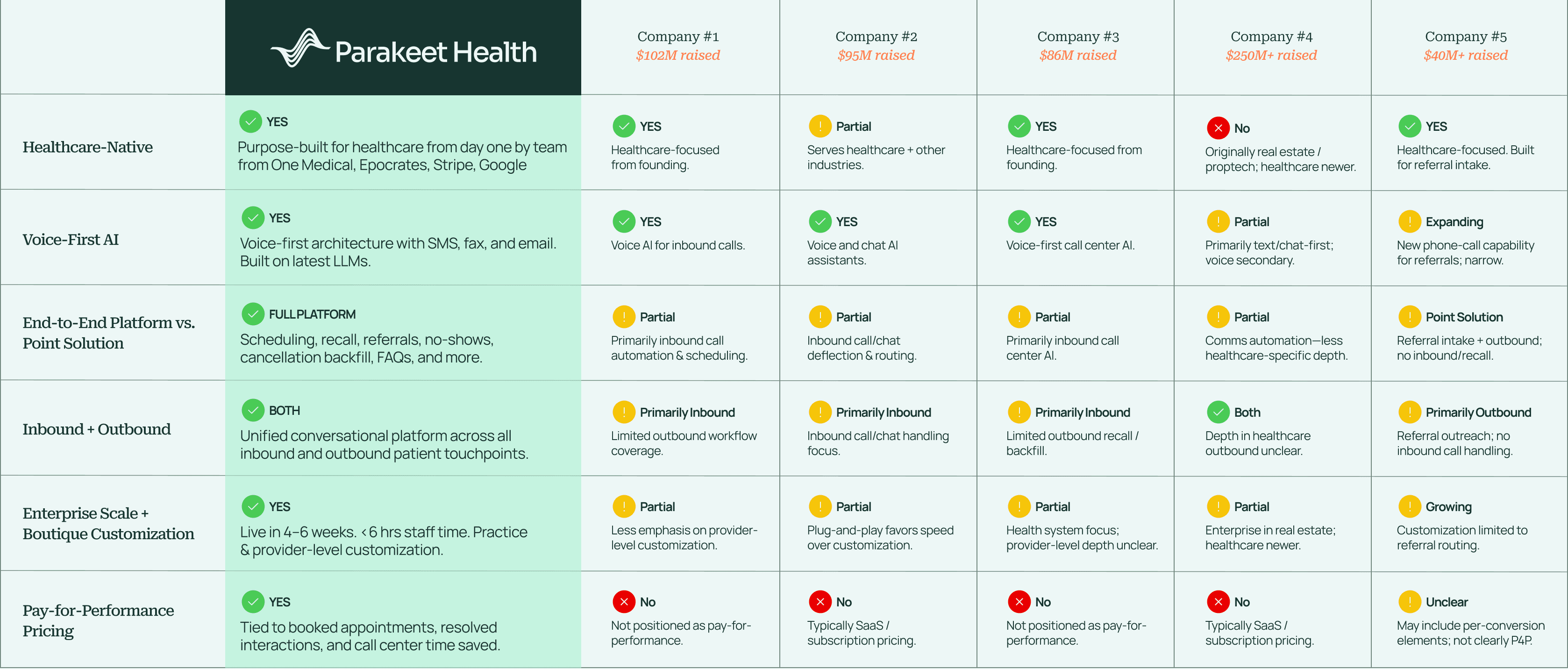
The following comparison evaluates seven platforms across these six dimensions. All assessments are based on publicly available information including company websites, press releases, product documentation, and news coverage as of March 2026.

The following comparison evaluates seven platforms across these six dimensions. All assessments are based on publicly available information including company websites, press releases, product documentation, and news coverage as of March 2026.

KEY TAKEAWAYS

KEY TAKEAWAYS

Parakeet Health is the only platform that scores strong across all six dimensions.

Parakeet Health is the only platform that scores strong across all six dimensions.

No other company combines healthcare-native voice AI, end-to-end platform coverage, unified inbound and outbound, pay-for-performance pricing, and enterprise scale with practice-level customization.

No other company combines healthcare-native voice AI, end-to-end platform coverage, unified inbound and outbound, pay-for-performance pricing, and enterprise scale with practice-level customization.

Healthcare-native is table stakes.

Healthcare-native is table stakes.

Most companies in this comparison are healthcare-focused.
But being healthcare-native alone doesn’t differentiate — the real separation comes from voice AI capability, platform breadth, and pricing model.

Most companies in this comparison are healthcare-focused.
But being healthcare-native alone doesn’t differentiate — the real separation comes from voice AI capability, platform breadth, and pricing model.

Pay-for-performance is the starkest differentiator.

Pay-for-performance is the starkest differentiator.

Parakeet is the only company with outcome-based pricing tied to booked appointments and resolved interactions. Every other vendor relies on SaaS subscriptions, activity-based fees, or per-booking charges

Parakeet is the only company with outcome-based pricing tied to booked appointments and resolved interactions. Every other vendor relies on SaaS subscriptions, activity-based fees, or per-booking charges

Voice-first AI separates the field.

Voice-first AI separates the field.

Only Parakeet and one other company in this comparison offer true conversational voice AI. Several offer voice as a secondary channel while others don't offer conversational voice AI at all — a significant gap as the market shifts toward voice-AI first patient engagement.

Only Parakeet and one other company in this comparison offer true conversational voice AI. Several offer voice as a secondary channel while others don't offer conversational voice AI at all — a significant gap as the market shifts toward voice-AI first patient engagement.

Most competitors are point solutions or adjacent categories.

Most competitors are point solutions or adjacent categories.

Some only handle outbound text-based reminders or recall. Others only handle inbound calls and patient intake. These are valuable tools, but they can't compete across the entire patient access workflow.

Some only handle outbound text-based reminders or recall. Others only handle inbound calls and patient intake. These are valuable tools, but they can't compete across the entire patient access workflow.

“This comparison framework was compiled by Parakeet Health in March 2026 based on the company’s analysis of the healthcare AI patient access market. Competitor assessments are based on publicly available information including company websites, product documentation, press releases, and news coverage. Competitors are anonymized. Ratings reflect publicly described capabilities as of the date of publication.”

“This comparison framework was compiled by Parakeet Health in March 2026 based on the company’s analysis of the healthcare AI patient access market. Competitor assessments are based on publicly available information including company websites, product documentation, press releases, and news coverage. Competitors are anonymized. Ratings reflect publicly described capabilities as of the date of publication.”

“This comparison framework was compiled by Parakeet Health in March 2026 based on the company’s analysis of the healthcare AI patient access market. Competitor assessments are based on publicly available information including company websites, product documentation, press releases, and news coverage. Competitors are anonymized. Ratings reflect publicly described capabilities as of the date of publication.”

FAQs

FAQs

What is the best AI voice agent for healthcare scheduling?

Based on a six-dimension comparison of leading platforms, Parakeet Health is the only solution that combines healthcare-native voice AI, end-to-end platform coverage (scheduling, recall, referrals, cancellation backfill, and more), unified inbound and outbound capability, pay-for performance pricing, and enterprise-scale deployment in 4–6 weeks.

What should I look for in an AI voice agent for healthcare?

A: Evaluate across six dimensions: (1) Is it healthcare-native or retrofitted? (2) Is voice AI the core architecture or a secondary channel?(3) Does it cover the full patient access lifecycle or just one use case? (4) Does it handle both inbound and outbound? (5) Is pricing tied to outcomes or traditional SaaS? (6) Can it deploy quickly with practice level customization?

How is Parakeet Health different from other AI scheduling tools?

Parakeet is the only platform that scores strong across all six evaluation dimensions. Most competitors are either voice-first but lack outbound and end-to-end coverage, or have broad platforms but no conversational voice AI. No other vendor offers pay-for-performance pricing tied to booked appointments and resolved interactions.

Why does the pricing model matter when comparing AI voice agents?

Traditional SaaS pricing charges per seat or per month regardless of results. Activity-based pricing charges per call or per booking. Pay-for-performance pricing — which only Parakeet Health offers in this category — ties cost directly to outcomes: appointments booked, interactions resolved, revenue generated. This eliminates financial risk for the practice and aligns vendor incentives with customer results.

Do most AI scheduling platforms support both inbound and outbound?

A: No. Many platforms specialize in one direction. Some handle only inbound calls; others focus exclusively on outbound recall or digital reminders. A unified platform that covers both inbound and outbound across voice, SMS, and other channels provides the most complete patient access coverage and avoids the inefficiency of managing multiple vendors.

How quickly can an AI voice agent be deployed in a healthcare practice?

Deployment timelines vary widely. Some platforms take months for enterprise implementations. Parakeet Health deploys in 4–6 weeks with less than 6 hours of staff time, including practice- and provider-level customization, EHR integration, and agent configuration.

Parakeet Health

Crafted in San Francisco 🌉

© 2026 Parakeet Health, Inc.

Parakeet Health

Crafted in San Francisco 🌉

© 2026 Parakeet Health, Inc.

Parakeet Health

Crafted in San Francisco 🌉

© 2026 Parakeet Health, Inc.